
- Research,
"Modeling urban mobility to inform public decision-making": insights from Manon Prédhumeau, lecturer in the Faculty of Computer Science
• Could you briefly outline your background and what led you to UT Capitole?
I completed all my studies in computer science and initially intended to pursue a short course of study. After a two-year technical degree (DUT) in Clermont-Ferrand, I went on to an engineering school at the Institut d'informatique d'Auvergne (ISIMA).
My first internship at the National Research Institute of Science and Technology for Environment and Agriculture (Irstea) sparked my interest in research, which I further developed through a dual degree combining a research master’s and an internship at the Laboratory of Image and Information Systems (LIRIS) in Lyon. I then completed a PhD at the Grenoble Computer Science Laboratory, during which I discovered that I enjoyed teaching just as much as research.
After a postdoctoral position at the University of Leeds, I joined Toulouse Capitole University and the Toulouse Computer Science Research Institute (IRIT) in 2024 as an Associate Professor, where I have been able to sustainably combine these two dimensions.
My first internship at the National Research Institute of Science and Technology for Environment and Agriculture (Irstea) sparked my interest in research, which I further developed through a dual degree combining a research master’s and an internship at the Laboratory of Image and Information Systems (LIRIS) in Lyon. I then completed a PhD at the Grenoble Computer Science Laboratory, during which I discovered that I enjoyed teaching just as much as research.
After a postdoctoral position at the University of Leeds, I joined Toulouse Capitole University and the Toulouse Computer Science Research Institute (IRIT) in 2024 as an Associate Professor, where I have been able to sustainably combine these two dimensions.
• What are your main research areas?
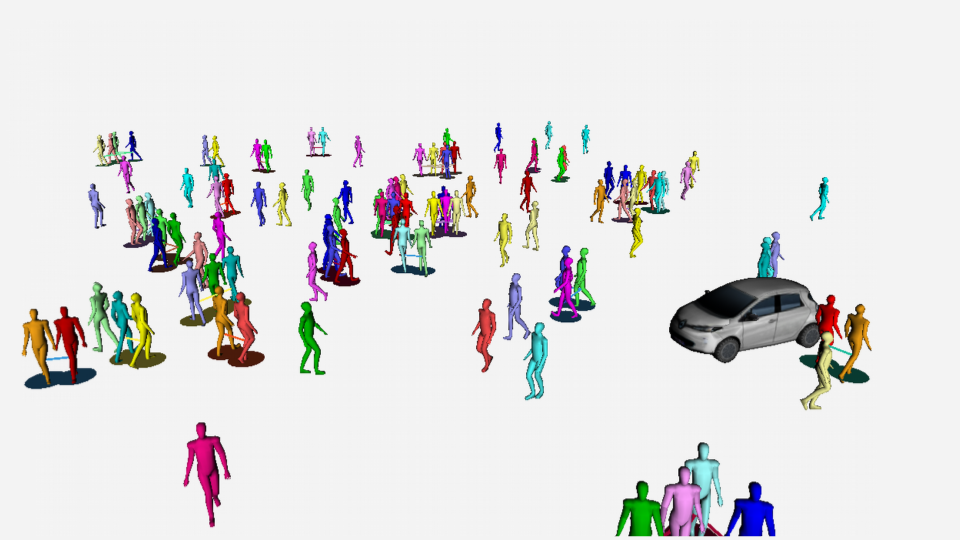
Pedestrian simulation in shared spaces with autonomous vehicles
Since my final-year internship, I have been interested in urban mobility behaviors, that is, how individuals move within cities. Cities are complex systems composed of a wide diversity of individuals interacting at different scales. I develop computational models to represent these movements and to explore various urban scenarios through simulation.
These models are known as “agent-based” because they describe individual behaviors that give rise to complex collective dynamics. For example, to enable autonomous (driverless) vehicles to operate safely among pedestrians, it is necessary to test their navigation systems under conditions close to reality.
We can create a model in which each pedestrian is represented as an agent with relatively simple behaviors, then simulate realistic urban scenes, such as a crowded public square, to observe the emergence of crowd flows and how an autonomous vehicle can navigate within them.
This approach makes it possible to study many urban phenomena (pedestrian flows, mobility needs of older adults, responses to traffic disruptions, or the impact of traffic on urban heat islands), and to explore forward-looking scenarios in order to anticipate the effects of decisions or public policies.
These models are known as “agent-based” because they describe individual behaviors that give rise to complex collective dynamics. For example, to enable autonomous (driverless) vehicles to operate safely among pedestrians, it is necessary to test their navigation systems under conditions close to reality.
We can create a model in which each pedestrian is represented as an agent with relatively simple behaviors, then simulate realistic urban scenes, such as a crowded public square, to observe the emergence of crowd flows and how an autonomous vehicle can navigate within them.
This approach makes it possible to study many urban phenomena (pedestrian flows, mobility needs of older adults, responses to traffic disruptions, or the impact of traffic on urban heat islands), and to explore forward-looking scenarios in order to anticipate the effects of decisions or public policies.
• Could you share a concrete example or a recent project that illustrates your work?
A concrete example of my work is the RAIM project (Responsible Automation for Inclusive Mobility), conducted while I was at the University of Leeds. With an ageing population, addressing the mobility needs of older adults is a major challenge: in both Canada and the United Kingdom, nearly 22% of the population will be aged 65 or over by 2030. Among the solutions being considered, on-demand autonomous mobility systems based on door-to-door autonomous shuttles could offer an alternative to private cars for seniors.
To assess the potential demand for such a service, we developed a model of urban mobility in the cities of Winnipeg (Canada) and Birmingham (United Kingdom). The population is represented by agents, each following a daily routine based on their characteristics, making it possible to simulate a wide range of behaviors.
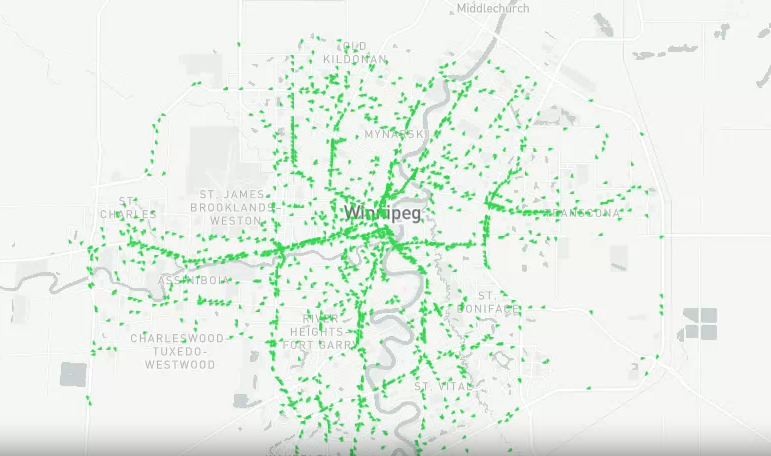
Urban mobility simulation in Winnipeg, Canada
The model can then be used to test different scenarios, anticipate service usage, estimate the number of shuttles required, and evaluate the overall impact on mobility. This work was carried out in partnership with local transport authorities to inform the planning of future services..
• How does your research interact with other disciplines or approaches, and what do these exchanges bring you?
Cities are inherently multidisciplinary subjects. I have worked with robotics specialists on interactions between pedestrians and autonomous vehicles. I also collaborate with researchers in the social sciences, whose approaches help better understand the mobility needs of older adults and how pedestrians perceive risk. I work as well with researchers in transport and geography, and I am in contact with climatologists specializing in urban environments.
These exchanges make it possible to confront different perspectives and sometimes combine approaches to build more robust models. This interdisciplinary openness allows us to address the same problem from multiple angles and to generate new ideas.
These exchanges make it possible to confront different perspectives and sometimes combine approaches to build more robust models. This interdisciplinary openness allows us to address the same problem from multiple angles and to generate new ideas.
• How does your research help address current societal challenges or inform the socio-economic world?
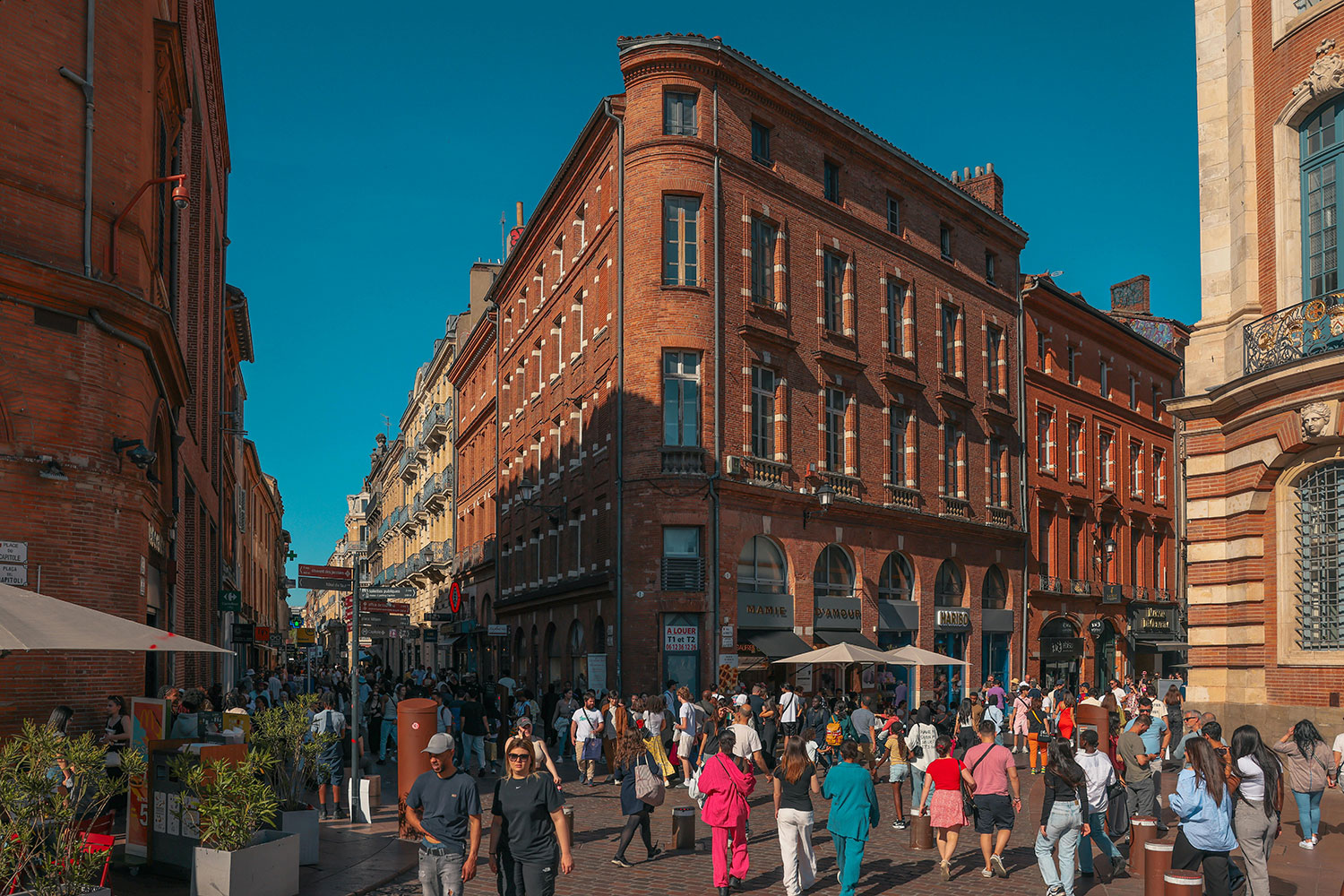 My research directly contributes to addressing current societal challenges, as urban mobility is a key factor in quality of life, access to services, and social inclusion. Urban transport influences people’s daily lives, their health, their free time, and their participation in economic and social life. In a context of rapid change driven by population ageing, urbanization, and technological innovation, it is essential to have tools capable of anticipating future developments..
Agent-based models are particularly useful because they make it possible to represent the diversity of behaviors and to focus on specific groups rather than an “average” individual. They allow us to virtually test different solutions before implementation, such as the introduction of autonomous vehicles in shared spaces or on-demand shuttles for older adults.
These simulations do not predict the future, but they make it possible to explore different possible scenarios and anticipate unintended consequences, providing urban planners with concrete tools to inform their decisions.
• What motivates you most in your work as a researcher and in the prospects of your research?
What motivates me most in my work as a teacher-researcher is intellectual stimulation. I value exchanges with other researchers, whether through discussions, reading articles, or sharing ideas. Above all, I enjoy being able to devote time to thinking deeply about a problem, exploring different approaches, and combining creativity, technical skills, and scientific rigor.
Passing on this passion to students and PhD candidates is also essential to me: sparking their curiosity for research and supporting them in their learning are among the most rewarding aspects of my work.
In my research, I am particularly passionate about modeling human behavior and decision-making. Being able to use these models to explore possible futures and reflect on their implications is both intellectually stimulating and socially useful.
Passing on this passion to students and PhD candidates is also essential to me: sparking their curiosity for research and supporting them in their learning are among the most rewarding aspects of my work.
In my research, I am particularly passionate about modeling human behavior and decision-making. Being able to use these models to explore possible futures and reflect on their implications is both intellectually stimulating and socially useful.