
- Research,
More effective AI for detecting anomalies, recognized internationally

on the May 6, 2026
Researchers from IRIT have just received the Springer IDA 2026 Frontier Prize, which recognizes the most innovative contribution to data analysis at the Intelligent Data Analysis 2026 scientific conference. The paper, authored by researchers from the School of Computer Science at the Toulouse Capitole University, ranked first out of 102 submissions. This work proposes a new approach to making artificial intelligence more effective at detecting anomalies in complex data.
How can you spot fraud, a system failure, or unusual behavior when you don’t know in advance what you’re looking for? That is the whole point of anomaly detection, a key area of artificial intelligence used in robotics, finance, and healthcare.
To meet this challenge, researchers often combine multiple algorithms. One of the main obstacles is determining how to select these different algorithms to optimize results. A common strategy is to choose diverse algorithms that “think” differently. However, measuring algorithmic diversity remains a complex task.
The IRIT team (CNRS, UT, INPT, UT Capitole, UT2J) proposes an innovative approach: understanding how algorithms make their decisions, rather than simply accepting their results. Using explainability tools (known as SHAP), researchers analyze precisely which data elements influence each model. This allows them to compare algorithms not only based on their results, but also on how they “reason.”
Result:
To meet this challenge, researchers often combine multiple algorithms. One of the main obstacles is determining how to select these different algorithms to optimize results. A common strategy is to choose diverse algorithms that “think” differently. However, measuring algorithmic diversity remains a complex task.
The IRIT team (CNRS, UT, INPT, UT Capitole, UT2J) proposes an innovative approach: understanding how algorithms make their decisions, rather than simply accepting their results. Using explainability tools (known as SHAP), researchers analyze precisely which data elements influence each model. This allows them to compare algorithms not only based on their results, but also on how they “reason.”
- when two models are based on similar logic, they often detect the same anomalies;
- conversely, models that “explain” their decisions differently are truly complementary.
This discovery makes it possible to better select and combine models to build artificial intelligence systems that are both more powerful and more reliable. But the researchers emphasize a key point: diversity alone is not enough. To be effective, each model must also perform well on its own.
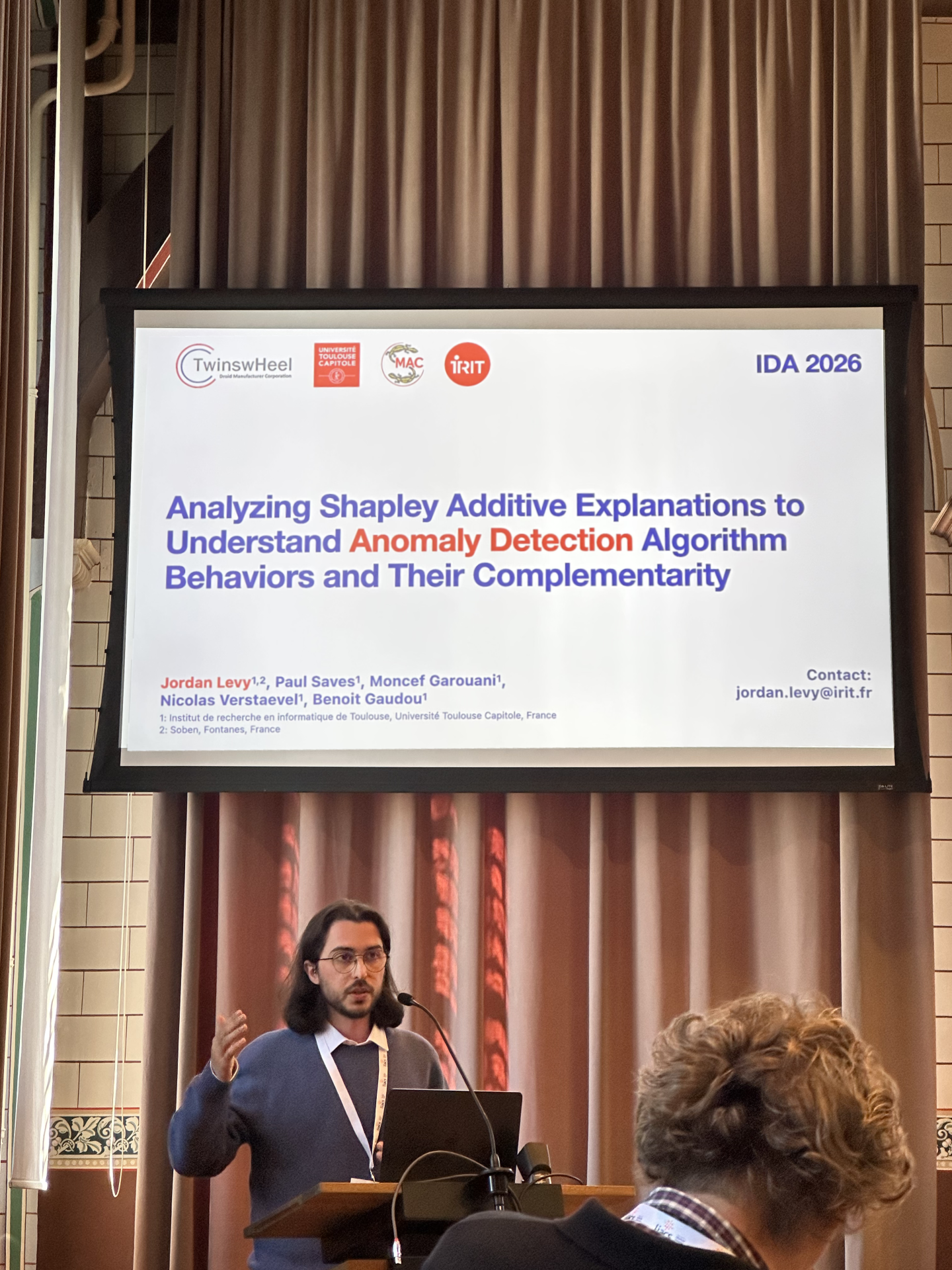
Jordan Levy presents his findings at the conference in Leiden (Netherlands)
Reference : Levy, J., Saves, P., Garouani, M., Verstaevel, N., Gaudou, B. (2026). Analyzing Shapley Additive Explanations to Understand Anomaly Detection Algorithm Behaviors and Their Complementarity. In: Baratchi, M., Nijssen, S., van Rijn, J.N. (eds) Advances in Intelligent Data Analysis XXIV. IDA 2026. Lecture Notes in Computer Science, vol 16513. Springer, Cham. https://doi.org/10.1007/978-3-032-23833-7_10
Updated on June 10, 2026
International recognition
This work, conducted as part of Jordan Levy’s doctoral thesis (in collaboration with Soben, the company that owns the TwinswHeel brand), was honored with the Frontier Prize at the 2026 Intelligent Data Analysis international conference. This award recognizes the most visionary contributions in the field, prioritizing scientific innovation over technical performance alone. Jordan Levy presented his findings at the conference in Leiden (Netherlands), confirming the international visibility of the research conducted in Toulouse.